JOURNAL HIGHLIGHTS
International Space Station used 3D human brain organoids from iPSCs to explore how microgravity affects neural development
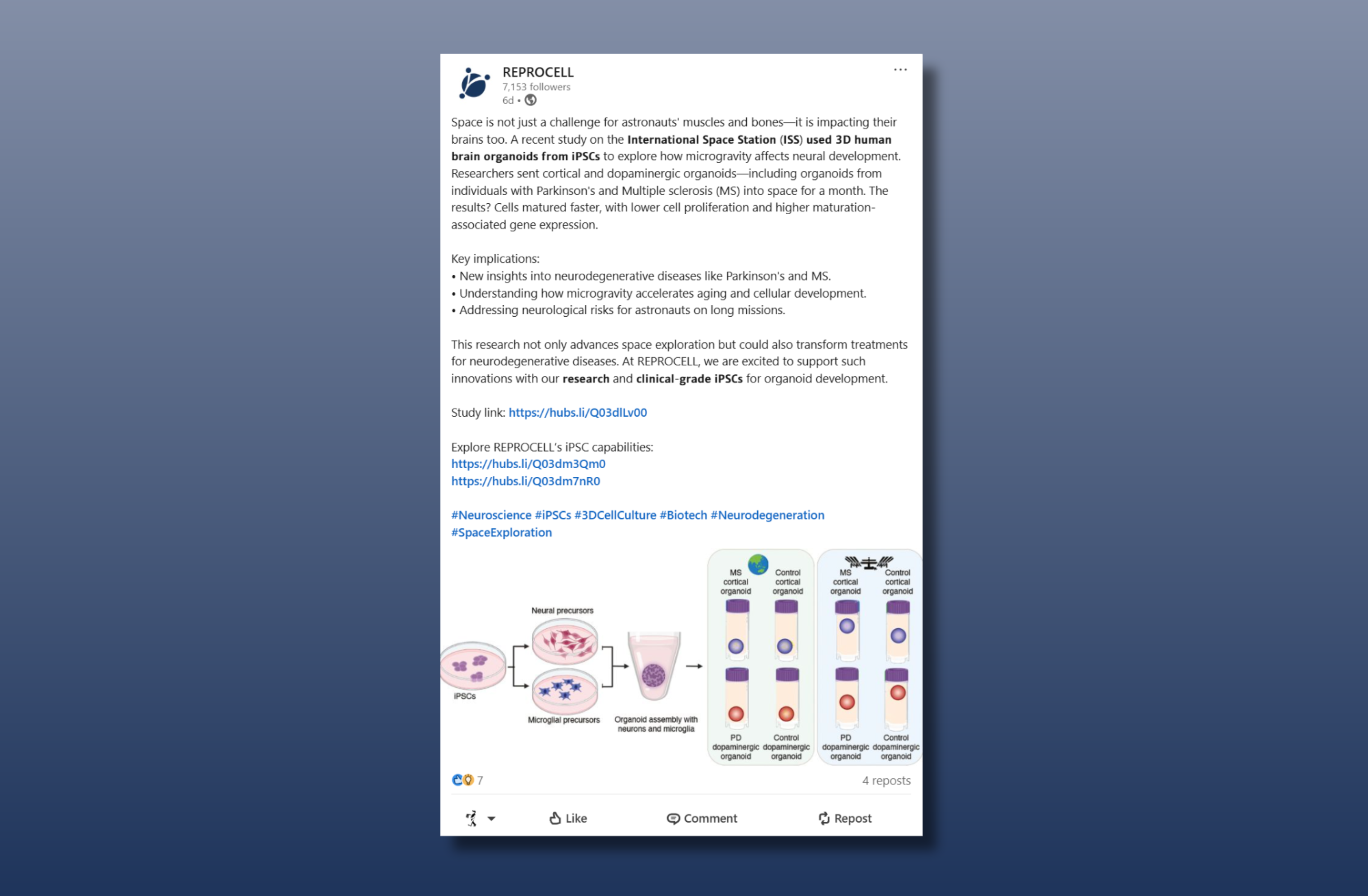
REPROCELL shared a journal highlight through their LinkedIn post, reporting an innovation using 3D human brain organoids from iPSCs to explore how microgravity affects neural development:
Space is not just a challenge for astronauts’ muscles and bones—it is impacting their brains too. A recent study on the International Space Station used 3D human brain organoids from iPSCs to explore how microgravity affects neural development. Researchers sent cortical and dopaminergic organoids—including organoids from individuals with Parkinson’s and Multiple sclerosis (MS) into space for a month. The results? Cells matured faster, with lower cell proliferation and higher maturation-associated gene expression.
Key implications:
- New insights into neurodegenerative diseases like Parkinson’s and MS.
- Understanding how microgravity accelerates aging and cellular development.
- Addressing neurological risks for astronauts on long missions.
This research not only advances space exploration but could also transform treatments for neurodegenerative diseases.